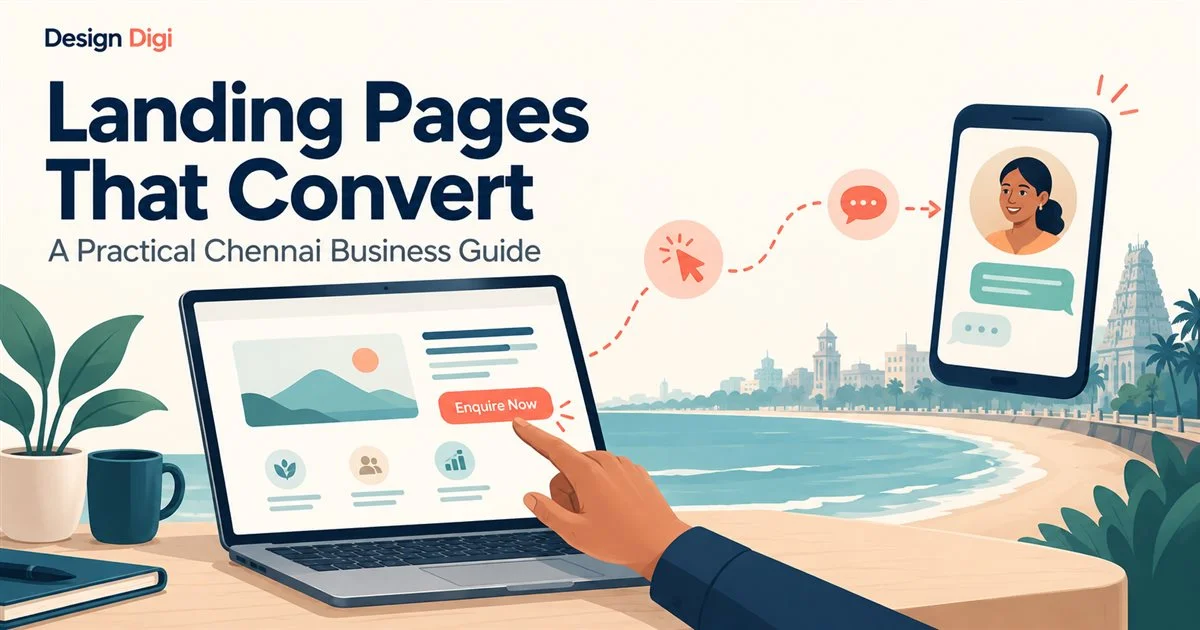
Someone clicks your advertisement because it promises a relevant service. Your landing page has to continue that conversation: confirm the offer, answer the important questions and make the next step easy. This landing page optimisation checklist helps Chennai businesses turn that principle into a page they can build, test and improve.
It is useful for service enquiries, consultations and appointment requests. A page cannot guarantee leads, but it can remove avoidable confusion between an ad click and a genuine conversation. If you need help implementing the structure, see our landing page design services in Chennai.
Start with one audience, one offer and one main action
Before writing copy, complete this sentence: “This page helps [specific customer] enquire about [specific service] by [next step].” If the sentence contains several unrelated audiences and offers, consider separate pages.
For a hypothetical interiors business, the brief might be: “This page helps Chennai apartment owners request a modular kitchen consultation.” The page should explain that consultation, show relevant work and collect enough information to arrange it. It should not open with a long list of every design service the business has ever offered.
Choose a primary action such as “Request a consultation” or “Get a project estimate.” Calls and WhatsApp can be secondary routes where the team can manage them reliably. Keep the labels clear about what happens after a click.
1. Match the advertisement to the first screen
Compare the search or ad message with the headline, supporting text and main button. If an ad mentions a particular service, location or offer, make those details easy to find on the destination page. Do not force a visitor to search a general homepage for the promised information.
Google considers relevance, usefulness, navigation and whether the page meets expectations when assessing landing page experience. That supports a simple working rule: deliver what the click promised.
Hypothetical example: an ad for an appointment-based kitchen consultation should lead to a headline such as “Plan Your Chennai Kitchen Renovation,” a short explanation of the consultation, and a button to request it. Only mention a free visit, turnaround time or discount when the business can actually honour it.
2. Use a structure that answers buying questions
| Page section | Visitor’s question | Useful content |
|---|---|---|
| Opening section | Is this relevant to me? | Specific service, audience, location where relevant and clear action |
| Service details | What do I receive? | Inclusions, exclusions and practical benefits |
| Evidence | Why should I trust you? | Relevant real work, attributable feedback and accurate credentials |
| Process | What happens next? | Steps from enquiry to consultation or delivery |
| FAQs | What could prevent me from proceeding? | Coverage, pricing factors, preparation and timing |
| Enquiry section | How do I start? | Short form, contact alternatives and next-step explanation |
Use this as a writing order, not a requirement to make every page long. A familiar, simple service may need little explanation; a larger project may need detailed proof and qualification. Remove paragraphs that repeat a claim without answering another question.
3. Show evidence that belongs to the service
A specific project image with a short explanation is more useful than a generic claim to be “the best.” Describe the problem, the work delivered and any outcome you can substantiate. Obtain permission for client names, logos, testimonials and images.
If you do not have verified results for the exact service, explain the process honestly. Never invent testimonials, client counts or percentage improvements. Our project portfolio is a starting point for understanding how work can be organised around services; select evidence that matches the offer you are promoting.
4. Make the mobile enquiry easy

Open the page on a real phone and try to enquire using one hand. Check whether the opening text is readable, buttons are easy to tap, fields have visible labels and error messages explain what to fix. A persistent button should not cover the form or important information.
Start with fields your team needs to respond: name, a contact method and a short description of the requirement. Add qualifying questions only when they help route or assess the request. Requiring a full address before an initial conversation may create unnecessary work for the visitor.
Compress large images, avoid distracting autoplay media and check the page on an ordinary mobile connection. Google’s mobile advertising guidance reinforces the importance of aligning ads and mobile destinations. For a broader website improvement, review our website design services.
5. Explain what happens after the form is sent
A useful confirmation tells the visitor that the request was received and what the business will do next. State a response time only if your team can maintain it. Keep a visible contact alternative for an urgent or failed submission.
Test the whole journey before running ads: submit an enquiry, confirm it reaches the right inbox or system, check the notification on a staff member’s phone and reply as the business would. Test invalid details and repeated clicks as well. A working button is not enough if nobody receives the enquiry.
Link to your privacy information beside the form and collect only information needed for the enquiry. Do not put names, phone numbers or email addresses into tracking URLs.
6. Measure qualified enquiries, not just button clicks

Define success before reviewing a dashboard. A phone-button tap is an interaction; a connected conversation is different. A form submission is a lead; a suitable customer request is a qualified lead. Keep those stages distinct when evaluating campaigns.
- Enquiry rate: valid enquiries divided by landing-page sessions, using the same reporting period and a consistent definition.
- Qualified lead rate: qualified enquiries divided by valid enquiries.
- Cost per qualified lead: campaign spend divided by qualified leads attributed to that campaign.
- Follow-up outcome: whether the enquiry progressed to an appointment, estimate or sale.
For a purely hypothetical calculation, 500 sessions producing 20 valid enquiries gives a 4% enquiry rate. If eight are qualified, the qualified lead rate is 40%. These figures illustrate the maths; they are not benchmarks or Design Digi client results.
Make sure your tracking records a successful form submission rather than every submit-button click. Review duplicates and spam, and give campaign and website reports the same date range. Our PPC services in Chennai connect campaign planning with the enquiry journey.
7. Improve one important issue at a time
Use actual objections and enquiries to choose a change. If visitors ask what is included, clarify the offer. If the form fails on mobile, fix it before testing button colours. If enquiries are consistently outside your service area, state coverage clearly and check campaign targeting.
For a formal comparison, choose the main outcome and test period before starting, keep traffic conditions as comparable as possible and avoid declaring a winner from a handful of leads. Low-traffic businesses may learn more initially from watching customers use the page and checking enquiry quality.
If the problems affect the whole website, our guide to signs your website needs a redesign can help you assess the wider scope.
Pre-launch checklist
- The headline and offer match the ad.
- The service, coverage and main action are clear.
- Claims, photos and testimonials are accurate and authorised.
- The form works on mobile and sends to the correct destination.
- The confirmation explains the next step.
- Phone and other contact links work.
- Tracking distinguishes interactions from successful enquiries.
- A named person owns follow-up and checks lead quality.
Frequently asked questions
Should every Google Ads campaign go to the homepage?
No. Choose the destination that answers the intent behind the ad. A specific service offer often benefits from a focused landing page, while a brand-focused visit may be served by the homepage.
Can a landing page also support organic SEO?
Yes, when it is a useful, accessible page with a distinct purpose and substantive information. Avoid creating many near-identical pages solely to target keyword variations. Paid campaign variants need a considered indexing and canonical strategy.
What is a good landing-page conversion rate?
There is no single useful target for every business. Compare your own consistent measurement over time and consider enquiry quality, offer value, traffic source and follow-up capacity.
Build a clearer route from click to conversation
The strongest next step is usually practical: align the offer, answer the visitor’s questions and test the enquiry journey end to end. To plan a page around your service and campaign, contact Design Digi with your offer, target audience and current destination page.